Marseille in a Day
The Old Port, the Panier, and France’s Oldest City
Marseille is not like the rest of Provence. It is older — 2,600 years old, founded by Greek sailors from Asia Minor in 600 BC, which makes it the oldest city in France by several centuries. It is bigger — nearly 900,000 people, the second-largest city in the country after Paris. It is rougher, louder, more Mediterranean, more North African, more Italian, more everything. While the rest of Provence is lavender fields and hilltop villages and long lunches under plane trees, Marseille is a working port city with a soccer team that locals treat as a religion, a soap industry that has been going for 600 years, and a food tradition built around what fishermen pulled out of the harbor that morning.
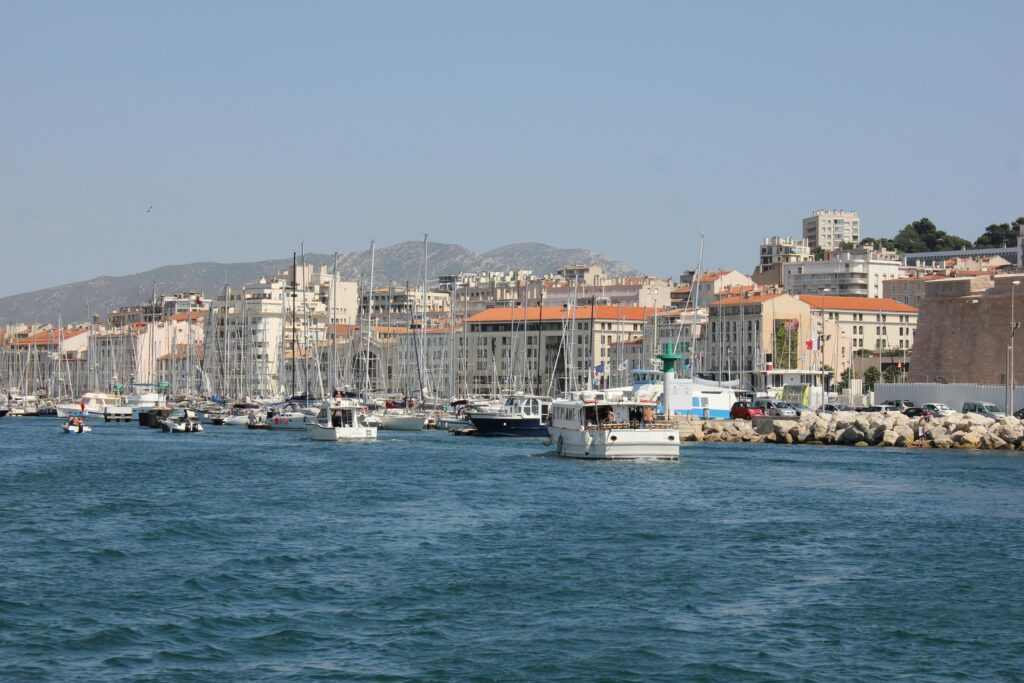
Most visitors to Provence skip Marseille, or pass through it only long enough to catch a ferry to Corsica. This is a mistake. Marseille is not pretty in the way Avignon or Aix is pretty. It is better than pretty. It is alive. And with one well-planned day, you can see enough of it to understand why the people who live here love it with the kind of fierce, defensive loyalty you usually reserve for family members.
Start at the Old Port (Vieux-Port)
Every visit to Marseille begins at the Vieux-Port — the Old Port — because the entire city began at the Vieux-Port. The rectangular harbor at the center of the city, lined with cafés on three sides and open to the Mediterranean on the fourth, is the exact same harbor the Greek sailors from Phocaea used when they landed here in 600 BC. The city has been built and rebuilt around it for 26 centuries. Roman galleys tied up here. Medieval crusaders launched from here. 19th-century steamships took millions of French colonists to Algeria from these docks.
In 1943, the Germans dynamited the old neighborhoods along the north side of the port during their occupation because they couldn’t control the warren of narrow streets. And every morning at dawn, still today, a small fleet of local fishermen brings the previous night’s catch into the port and sells it directly off the boats at the Marché aux Poissons — the fish market — on the Quai des Belges at the foot of the port.
Start your day here. Arrive by 8 a.m. if you want to see the fish market at its best; by 10 the vendors are packing up. The market is small — maybe a dozen stalls, each manned by the wife or family of the fisherman who caught the fish that morning — but it is one of the most authentic pieces of daily life in Marseille.
You will see species you have never seen before: vive (weever fish), rascasse (scorpion fish, the essential ingredient in bouillabaisse), chapon (another scorpion species), live sea urchins, live crabs still crawling around in plastic tubs. The fishermen and their families have been doing this for generations. Some of the boats in the harbor are owned by families that have been fishing these waters since before the French Revolution.
Walk the length of the port. Stop for a coffee at one of the cafés. Look up at the two forts guarding the harbor entrance — Fort Saint-Jean on the north side and Fort Saint-Nicolas on the south — both built in the 17th century by Louis XIV, who famously had the forts’ guns pointed inward at the city rather than out at the sea. Louis, it turned out, was more worried about the people of Marseille than about anyone sailing in from the Mediterranean. He was not wrong. Marseille has always been the French city most skeptical of Paris.
Climb to Notre-Dame de la Garde
From the Old Port, look south and up. The tallest point in the city is crowned by a 19th-century basilica with a gilded statue of the Virgin Mary on top of its bell tower. This is Notre-Dame de la Garde — or, as locals call her, La Bonne Mère, “the Good Mother” — and she watches over Marseille from the highest hill in the city, 154 meters above sea level.
You can walk up (a long, steep climb) or take the small tourist train or a bus. However you get there, go. The basilica itself is a Byzantine-Romanesque confection of striped marble inside and out, covered in votive offerings left by sailors and their families — model ships hanging from the ceiling, marble plaques thanking the Virgin for surviving storms and wars, paintings of shipwrecks and rescues. It is one of the more affecting religious interiors in France, not for its art-historical importance but for the sheer weight of centuries of gratitude from people whose lives depended on the sea.
The real reason to come up here, though, is the view. From the terrace around the basilica, you can see all of Marseille spread out below you: the Old Port with its forest of sailboat masts, the red-tile roofs of the old city, the 19th-century apartment buildings of the modern downtown, the industrial port stretching north along the coast, the islands in the harbor (including the small rocky Château d’If — the prison from The Count of Monte Cristo — which you can just barely make out offshore), and beyond everything, the blue Mediterranean stretching to the horizon.
On a clear day you can see almost 50 kilometers of coastline. This is the view that tells you what Marseille is: a city wedged between mountains and the sea, with nowhere to go but up or out.
Le Panier: The Oldest Neighborhood
Come back down to the Old Port and walk north into Le Panier, the oldest neighborhood in Marseille. Le Panier — “the basket” — is a warren of steep, narrow streets climbing the hill on the north side of the port, full of pastel-colored buildings, tiny squares with working fountains, laundry hanging from windows across the street from each other, and graffiti ranging from tourist-level scrawl to serious street art.
It is the oldest inhabited quarter in France, built on the site of the original Greek settlement of Massalia. Romans lived here. Medieval merchants lived here. In the 19th and 20th centuries, waves of immigrants — Italians, Corsicans, Armenians, Algerians, Tunisians, Senegalese, Comorians — landed here and built their first lives in France in these same narrow streets.
Le Panier was rough for much of the 20th century. The Germans dynamited the lower portions of it during the war, and for decades afterward the neighborhood was poor, gritty, and avoided by most middle-class Marseillais. In the last 20 years, it has gentrified significantly — artists, small boutiques, and trendy cafés have moved in — but it has not been scrubbed clean in the way the tourist quarters of Paris or Rome have. It still feels lived-in and local. The shops are still small. The old ladies still yell at their husbands from upper-floor windows. Cats still sleep on doorsteps.
A few things to see in Le Panier:
- La Vieille Charité. A beautiful 17th-century almshouse built around a central chapel by the great Marseille architect Pierre Puget. Originally built to house the city’s beggars, it is now a cultural center containing two small museums (Mediterranean archaeology and African/Oceanic art) and one of the most elegant arcaded courtyards in France. Worth a visit for the building alone, even if you skip the museums.
- Place des Moulins. A small, quiet square at the top of the neighborhood, where 15 windmills once stood grinding wheat for the city. The mills are gone, but the square itself is one of the most peaceful spots in Marseille.
- The small artisan shops. Soap makers, ceramicists, candy shops, and specialty food stores line the narrow streets. The traditional Marseille soap — savon de Marseille — has been made in and around the city for over 600 years, and several shops in Le Panier sell soap made by the traditional method (boiled in copper cauldrons, cut into 600-gram cubes, stamped with the maker’s mark).
- Lunch at a tiny neighborhood restaurant. The best restaurants in Le Panier are the small, family-run places with handwritten menus and ten tables. Ask a local. Or pick one that is full of people who are clearly French and sit down.
The MuCEM and Fort Saint-Jean
Walk back down to the port and around to the north side, past the entrance to the harbor. Here, at the very edge of the water, is one of the most striking modern buildings in France: the MuCEM, the Museum of European and Mediterranean Civilizations, which opened in 2013 when Marseille was European Capital of Culture. The building is a dark concrete cube wrapped in an openwork lace-like lattice that throws shifting shadows on the walls behind it. A footbridge connects it to the adjacent Fort Saint-Jean, the 17th-century fortress at the mouth of the Old Port, which has been restored and integrated into the museum complex.
The museum’s permanent collection explores the shared history of the Mediterranean world — from ancient trade routes and migrations to modern immigration, food, language, and religion — and its rotating exhibitions are often excellent. But the real reason to come is the architecture and the views. A pedestrian path winds along the top of Fort Saint-Jean with panoramic views of the Old Port, the lighthouses, the open sea, and the modern museum building below. The path is free to walk even if you don’t visit the museum interior. At sunset, with the sky turning pink behind the basilica of Notre-Dame de la Garde across the water, it is one of the most beautiful free experiences in France.
Bouillabaisse: The Food of Marseille
You cannot go to Marseille and not eat bouillabaisse — or at least, you cannot do it honorably. Bouillabaisse is the signature dish of the city, a rich fish stew made with multiple species of Mediterranean rock fish, saffron, tomato, garlic, fennel, and orange peel, served in two courses: first the fragrant broth with croutons and rouille (a garlicky, saffron-colored mayonnaise), then the poached fish themselves on a separate platter. Real bouillabaisse is not cheap — expect to pay €60–80 per person at a proper bouillabaisse restaurant — and it requires advance notice at most places because the fish have to be sourced that morning.
A few things to know about eating bouillabaisse in Marseille:
- The Charter. In 1980, a group of Marseille restaurants signed a formal “Charter of Bouillabaisse” that specifies exactly which fish species must be included (at least four of the traditional rock fish, including rascasse), how it must be prepared, and how it must be served. Restaurants that follow the charter display it on their menu. These are the ones to trust for the real thing.
- Classic bouillabaisse restaurants. Chez Fonfon, Le Miramar, Chez Michel, and L’Épuisette are the most famous addresses. All require reservations, all are expensive, and all serve bouillabaisse that is worth the money if you only have one chance in your life to try it.
- Order it 24 hours in advance if possible. Many restaurants require a day’s notice to prepare bouillabaisse properly, because the broth takes hours and the fish need to be the freshest possible.
- Don’t judge it by tourist versions. Cheap bouillabaisse served immediately without warning is almost always a disappointment. If you want the real thing, commit to the real thing.
- If you can’t or won’t spring for it: The other great Marseille fish dish is the far more casual panisse (fried chickpea cakes, often sold as street food), or grilled fresh fish at any of the restaurants around the Old Port. Less iconic, much cheaper, and still wonderful.
What to Skip (in One Day)
Marseille has more than you can see in a day. If you only have one day, these are things that are worth coming back for but can reasonably be skipped on a first visit:
- The Château d’If. The island prison from The Count of Monte Cristo is visible from the coast but requires a boat trip out and back that eats a significant chunk of the day. If you love Dumas or literary pilgrimages, do it. Otherwise skip and look at it from Notre-Dame de la Garde.
- The Calanques. The spectacular white cliffs and turquoise inlets east of Marseille are one of the great natural wonders of Provence, but they deserve their own day. See our guide to the Calanques of Cassis for how to visit them properly.
- The Stade Vélodrome. The home stadium of Olympique de Marseille, the city’s beloved soccer team. Unless you are a serious soccer fan, probably not worth the trip out. If you are a serious soccer fan and there is a home game during your visit, absolutely go — the atmosphere is among the most intense in European football.
- La Canebière. The famous 19th-century main street of old Marseille is historically important but, in honesty, less atmospheric now than the smaller streets of Le Panier. Walk a block or two if you pass through it, but don’t make it a priority.
A Suggested One-Day Itinerary
Putting it all together, a realistic and satisfying one-day Marseille looks like this:
- 8:00 a.m. — Arrive at the Old Port. Walk to the fish market at the Quai des Belges. Watch the fishermen unload.
- 9:00 a.m. — Coffee and a croissant at a café on the south side of the port.
- 9:30 a.m. — Walk, bus, or take the small tourist train up to Notre-Dame de la Garde. Spend 45 minutes at the basilica and the terrace.
- 11:00 a.m. — Back down to the port, then walk into Le Panier. Wander the narrow streets. Stop at La Vieille Charité. Browse the soap shops.
- 12:30 p.m. — Long lunch in Le Panier at a small neighborhood restaurant. If you are having bouillabaisse, make your reservation ahead at a charter restaurant and plan the whole day around lunch.
- 3:00 p.m. — Walk back down to the port and across to the MuCEM. Walk the rooftop path of Fort Saint-Jean. Visit the museum if you have energy, or just enjoy the views.
- 5:00 p.m. — A drink at a café on the Old Port, watching the light change on the façades. Buy a bar of savon de Marseille to bring home.
- 7:00 p.m. — Dinner at a small fish restaurant on the south side of the port. Order whatever is fresh. Drink the local rosé from Cassis or the white from Bandol.
- After dark — Walk back along the port. The basilica is lit up on its hill. The boats creak. The city is loud and alive. You will understand why people love it.
Where Marseille Fits in a Provence Trip
Marseille is easy to reach from almost anywhere in Provence. It’s 30 minutes by train or car from Aix-en-Provence, 35 minutes from the Calanques of Cassis, and about an hour from Avignon. It’s also directly connected to Paris by TGV (three hours from Gare de Lyon), which makes it a natural southern anchor for a longer Provence trip — arrive in Marseille, spend a day, then work your way north through Aix, Avignon, and the Luberon villages before catching the train back to Paris from Avignon.
A six-day Provence tour from Paris typically folds Marseille into a southern swing that also covers Cassis, the Calanques, and Aix-en-Provence — the best way to see the coastal side of Provence alongside the classic inland sights.
The City That Doesn’t Apologize
Here is what makes Marseille different from the rest of Provence, and what you will either love or find overwhelming depending on your temperament. Marseille does not present itself to you. It does not curate itself. It does not soften its edges for the tourist trade. It is crowded and noisy and the traffic is terrible and the graffiti is everywhere and the beggars are real and the neighborhoods shift from gentrified to rough inside of a block. And it is also warm and generous and funny and proud and full of people who will talk to you on a café terrace for an hour without ever asking what you do for a living.
If you want the postcard Provence of lavender fields and sleepy hilltop villages, go to the Luberon. Marseille is a different thing entirely — Provence’s wild, loud, Mediterranean heart, a city that has been absorbing immigrants and trading goods and pulling fish out of the water for 26 centuries and is not about to change just because you have shown up with a camera.
Meet it on its own terms. Eat what the fishermen caught that morning. Drink the rosé. Climb up to the Good Mother. And at the end of the day, sitting on the terrace of a café on the Old Port with the sun going down behind Fort Saint-Jean, you will understand why the people who live here defend their city so fiercely. Marseille is not trying to be anywhere else. That is the whole point.
Ready to meet Marseille on its own terms? A six-day Provence tour from Paris folds Marseille together with Cassis, the Calanques, and Aix-en-Provence into a proper coastal swing — the Provence of fish markets and Mediterranean light, not just lavender fields.
Frequently Asked Questions
Is Marseille worth a day trip?
Yes, and it rewards a full one: the Vieux-Port and its fish market, the MuCEM on the harbor mouth, the Panier quarter’s lanes, and Notre-Dame de la Garde on the hilltop above.
How old is Marseille?
The oldest city in France: Greek settlers from Phocaea founded Massalia around 600 BC, and the Vieux-Port sits where their harbor did.
How do you get to Marseille from Paris?
The TGV runs Paris Gare de Lyon to Marseille Saint-Charles in about 3 hours 5 minutes, city center to city center.