The Lavender Fields of Valensole
When to Go, Where to Stand, and How to Photograph a Purple Ocean
There is a photograph that has been taken approximately ten million times, and if you have ever looked at Provence on Instagram, Pinterest, or the cover of a travel magazine, you have seen it. The foreground: a row of lavender stretching away toward the horizon in perfect parallel lines, each row an impossibly saturated purple. The middle distance: a single stone farmhouse, or a lone tree, or a small chapel. The background: a sky so blue it looks painted in. That photograph was almost certainly taken on the Plateau de Valensole, about an hour and a half east of Avignon, during a four-week window in late June and early July when the Provençal lavender is in full bloom.
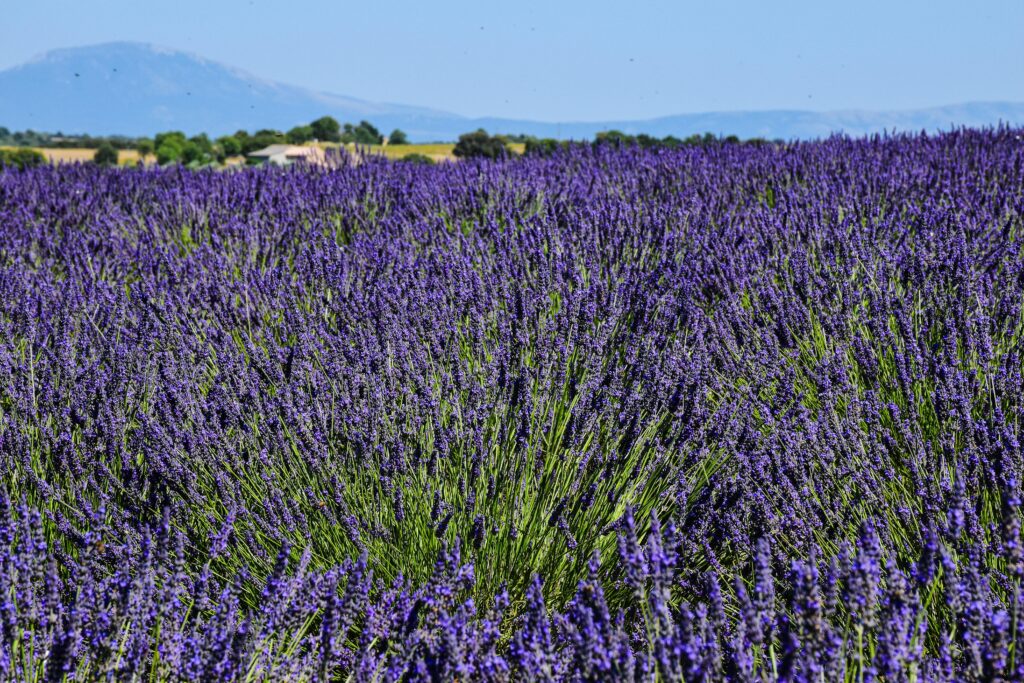
The Plateau de Valensole is the largest lavender-growing region in Provence, and for those few weeks each year it becomes one of the most photographed landscapes in the world. What most visitors don’t realize, until they get there, is how precisely timed the trip has to be, how much distance separates the famous shots, and how dramatically different the plateau looks at 6 a.m. versus 6 p.m. This is a guide to getting it right.
What Valensole Actually Is
Valensole is a small village — about 3,000 people — sitting on a high, open plateau in the Alpes-de-Haute-Provence, the more mountainous, less-visited eastern side of the region. Unlike the tight, dramatic hilltop villages of the Luberon, the plateau is wide and flat and sky-huge — 800 square kilometers of gently rolling farmland spread out between two rivers, the Verdon and the Asse. Almond trees, wheat, sunflowers, and, most famously, lavender.
The plateau’s altitude (around 500 meters) and its dry, well-drained soil turn out to be perfect for lavender cultivation. Farmers have grown it here for generations, originally for the perfume industry in nearby Grasse. Today most of what you see is actually lavandin, a hybrid cultivated for oil production — hardier, taller, and a deeper purple than true wild lavender. True lavender (lavande fine) grows at higher altitudes and in smaller quantities, mostly around the village of Sault further north. For photography, lavandin is what you want. It is denser, taller, and more dramatically purple.
The Four-Week Window
Here is the most important thing to understand about visiting the lavender fields: the bloom is short, and the timing varies slightly year to year depending on weather. In a typical year, the fields begin to turn purple in mid-to-late June, reach peak bloom in late June to early July, and are harvested starting around July 15.
A rough guide:
- Early June: Green fields, barely a hint of color. Too early.
- Mid-June: First purple appears. Photogenic but not yet dense.
- Late June to first week of July: Peak bloom. This is the window.
- July 10–15: Still beautiful, but harvesting begins and fields start coming down one by one.
- Mid-to-late July: Most of the main fields have been cut. Stubble and bare earth. Done.
If you are planning a trip specifically for the lavender, aim for the last week of June or the first week of July. Check with a local tourist office or lavender farm in the weeks before you go — Office de Tourisme de Valensole posts updates — because a hot spring or a late frost can shift the peak by a week in either direction.
The Famous Spots
There is no single “lavender field” at Valensole. The plateau is enormous, crisscrossed by small country roads, and the fields are scattered across a 40-square-kilometer area. The “famous” shots come from a handful of specific locations that photographers have agreed are the best. Here are the ones worth finding:
1. The Lone Tree (Arbre Solitaire)
A single dark tree standing in the middle of a vast lavender field. Probably the single most photographed tree in France during bloom season. It sits off the D8 road between Valensole and Puimoisson. Arrive at dawn — by 7 a.m. in peak season there can be 30 photographers set up around it.
2. The Stone Farmhouse
An old Provençal bastide — a stone farmhouse — surrounded on all sides by lavender rows. Several candidates exist on the plateau, but the most famous is along the D6 road toward Manosque. Classic Provence postcard composition.
3. The Chapel of Sainte-Croix
A tiny white chapel perched on a small rise, framed by lavender on all sides. Less crowded than the lone tree. Best in soft morning light.
4. Lavandes Angelvin
A working lavender farm and distillery on the plateau that has embraced the photography crowd without being ruined by it. You can walk into the fields (respectfully — stay on the paths between rows), buy lavender products from the farm shop, and see how the oil is distilled. One of the better places to understand that these are working fields, not just scenery.
5. The D8 and D6 driving loop
Honestly, the best strategy is to simply drive the small roads between Valensole, Puimoisson, and Riez with no fixed destination. Pull over when you see a field that stops you. The famous spots are beautiful, but the plateau is so vast that you will find your own field with no one else in it if you are willing to wander.
Dawn or Sunset?
Both, ideally. If you can only pick one, pick dawn.
Dawn (5:30–7:30 a.m.): Cool air, soft pink and gold light, and — critically — almost no one else there. The lone tree, which will have 30 photographers around it by 9 a.m., is empty at 6. The light is gentler, the colors are softer, and the bees are still asleep. (This matters. By mid-morning in peak bloom, the entire plateau is humming so loudly with honeybees that you can hear it from the road. It is not dangerous — the bees are completely uninterested in you — but it is surreal.)
Sunset (8:00–9:30 p.m. in June): Warmer, more dramatic light, and the famous “golden hour” that makes the purple look almost neon. Crowded at the popular spots, but the plateau is big enough that you can still find solitude away from the main photo stops. The disadvantage: the sun sets behind most of the famous fields, so you’re shooting into the light.
Midday is the worst time. The light is flat, the heat is intense (often over 95°F in peak season), and the bees are at maximum volume. Use midday for lunch in the village of Valensole itself and return to the fields in the late afternoon.
How to Photograph It Without Looking Like Everyone Else
A few practical tips from people who have spent time working these fields:
- Get low. The most dramatic lavender photos are taken from just above the tops of the plants, not from standing height. Crouch, kneel, or lie down in the dirt between the rows. Your back will thank you later. Your photos will thank you immediately.
- Use the rows as lines. Lavender is planted in perfect parallel rows that create natural leading lines toward whatever your subject is — the tree, the farmhouse, the horizon. Compose with those lines in mind.
- Include a subject. A photo of nothing but lavender is beautiful for about three seconds. A photo of lavender plus something — a tree, a building, a figure in the distance, a single wildflower — is memorable. That is why the famous spots are famous.
- Shoot wide and shoot tight. Wide-angle captures the scale. Macro captures the individual blooms and the bees. Both are worth having.
- Stay out of the fields. This is important. The lavender you see is a working crop. Walking into the rows, trampling plants for a photograph, or picking flowers damages the farmers’ livelihoods. Some fields now have signs in multiple languages asking people to stay on the dirt paths between plots. Respect this. You can get every photograph you want from the edges and the paths.
What Else to Do While You’re There
The plateau is remote enough that you will want to build at least a full day around a lavender visit, and ideally stay overnight in the area. A few things worth combining:
- Moustiers-Sainte-Marie. A beautiful village perched against a cliff about 20 minutes east of Valensole, famous for its faience pottery and for the gold star suspended on a chain between two cliffs above the town (a 1,000-year-old tradition of unclear origin).
- The Gorges du Verdon. Europe’s largest canyon, often called the “Grand Canyon of Europe,” starts just east of the lavender plateau. The turquoise river at the bottom is one of the most dramatic landscapes in France. A scenic drive along the canyon rim is unforgettable.
- Lac de Sainte-Croix. A large artificial turquoise lake at the mouth of the Verdon Gorges, excellent for swimming and kayaking on hot days.
- Distilleries and farm shops. Several working lavender distilleries on the plateau open their doors during bloom season, offering tours of the distillation process and shops selling essential oils, honey, and soaps made from the current year’s harvest.
Where to Base Yourself
Valensole is far enough from the main tourist hubs that a day trip from Avignon or Aix-en-Provence is possible but long — about 90 minutes each way, which makes an early-morning shoot difficult. If you are serious about lavender photography, the better strategy is to stay one or two nights somewhere close: the village of Valensole itself has a handful of small hotels and gîtes, and Moustiers-Sainte-Marie has more options with more charm. Book well in advance — rooms in peak bloom week are snapped up months ahead.
If you would rather skip the logistics, a guided tour that includes the plateau as part of a larger Provence itinerary is the simplest option. A five-day Provence tour from Paris can fold the lavender plateau into a week that also includes Avignon, the Luberon villages, and Aix — with a guide who knows the bloom timing and the less-crowded photo spots.
What to Expect If You Miss the Window
Lavender season is short, and not every traveler can plan a trip around four specific weeks in early summer. If you arrive in August or September, the main fields will be cut, and the plateau will look like any other stretch of farmland. Don’t panic. A few things are still possible:
- Some higher-altitude fields around Sault, north of Valensole, bloom later — sometimes into mid-August. Check locally.
- Distilleries and farm shops stay open all year and still sell lavender products from the current harvest.
- Many farms have small demonstration plots of unharvested lavender that remain photogenic well into late summer.
- The Musée de la Lavande in Coustellet (closer to the Luberon) tells the full story of Provençal lavender cultivation and is worth a visit any time of year.
Honestly, though: if you can time your trip for the bloom, time it for the bloom. There is no substitute. The photographs do not prepare you for the scale, or the scent — an entire plateau smelling of lavender on a warm June evening is a sensory experience no camera can capture. It is the kind of thing you travel for.
Planning to chase the bloom? A five-day Provence tour from Paris during peak lavender season can fold the Valensole plateau into a full Provence itinerary, with a guide who knows which fields are at their best that week.
Frequently Asked Questions
When does the lavender bloom at Valensole?
Roughly mid-June to mid-July, with harvest starting around mid-July. By August most fields are cut; for the postcard rows, the first two weeks of July are the safest bet.
Where exactly are the lavender fields?
Across the Valensole plateau east of Manosque, about an hour from Aix-en-Provence, with the best-known fields along the D6 and D8 near Valensole village and toward Puimoisson.
What time of day is best for the fields?
Early morning or the last two hours of light: cooler air, working bees, and low sun on the rows. Midday in July brings heat, tour buses, and flat light.