Pont du Gard
The Roman Aqueduct That Still Stops Traffic After 2,000 Years
You come around a bend in the road, cross a small ridge, and there it is — impossibly large, impossibly old, impossibly intact. Three tiers of honey-colored stone arches marching across a wooded river valley in the south of France. 160 feet tall at its highest point. 900 feet long. Built without mortar, held together by nothing but the precision of its own geometry and the weight of its own stones. It has been standing since roughly the year 50 AD. The Roman Empire built it, the Roman Empire fell, and the Pont du Gard simply kept standing.
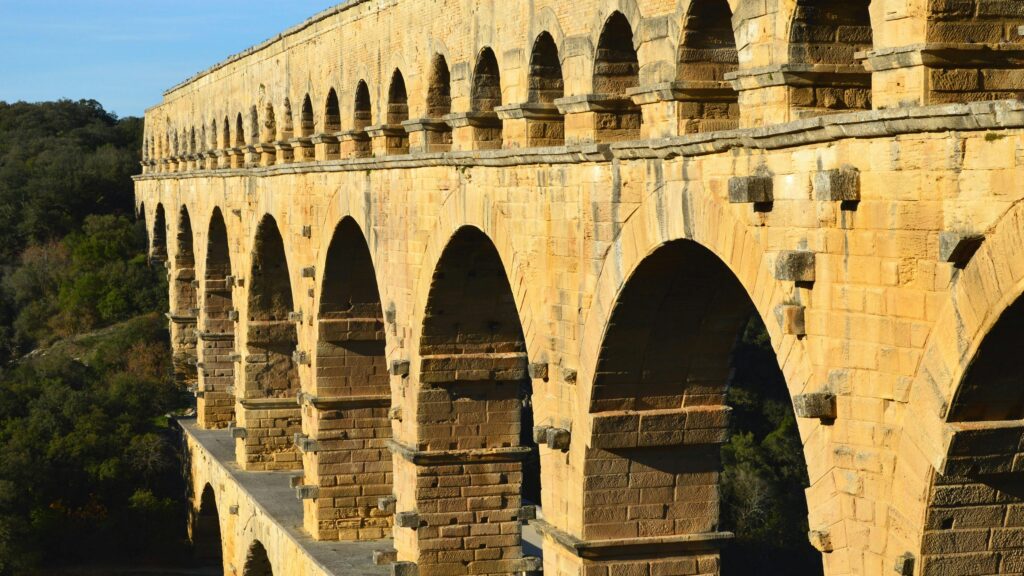
It is the tallest Roman aqueduct bridge in the world. It is a UNESCO World Heritage Site. It is one of the best-preserved pieces of Roman engineering anywhere on earth. And unlike the Colosseum or the Forum, it sits almost alone in a quiet river valley, surrounded by pine and scrub oak, with very little modern development in sight. When you stand at the base and look up, you are seeing essentially what a Gallo-Roman traveler would have seen 1,900 years ago.
What It Was For
The Pont du Gard was never a bridge in the way we normally mean the word. It was an aqueduct — a pipe. A single, specific segment of a 50-kilometer-long channel that carried fresh water from a spring near the town of Uzès to the Roman city of Nîmes, which the Romans knew as Nemausus. The channel ran underground for most of its length, following the natural contour of the landscape, but when it needed to cross the Gardon river, the Romans built this — the third tier of the structure, at the very top, contains the actual water channel. Everything below it is just support.
The engineering is staggering even by modern standards. Over its full 50-kilometer run, the aqueduct dropped only 12 meters in elevation — an average gradient of about 1 in 3,000, one of the most precise surveying achievements of the ancient world. The water flowed by gravity alone, at a rate of about 40,000 cubic meters per day, which is enough to supply a modern city of 50,000 people. It reached Nîmes in roughly 24 hours from source to destination. It ran for about 500 years before Roman authority collapsed and the system fell into disuse and disrepair in the 5th and 6th centuries.
How It Was Built
Here is the part that sounds like it cannot possibly be true. The Pont du Gard was constructed in about five years, using somewhere between 800 and 1,000 workers. The stones are enormous — the largest weigh around six tons each. They were quarried from a local site about 600 meters upstream, cut to fit, and hauled to the construction site using ropes, pulleys, and wooden hoists. No cement. No mortar. The stones were dressed so precisely that they simply locked together, supported by a system of wooden scaffolding and centering arches that was removed once each tier was complete.
You can still see the evidence of the construction process. All over the bridge, protruding blocks stick out from the façade — these are not decorative. They are the remnants of the stone “shelves” that once supported the wooden scaffolding during construction. The Romans could have trimmed them off when the bridge was finished. They didn’t bother. Nearly two millennia later, the scaffolding stubs are still there, waiting for a workman who will never come back.
Numbered construction marks are also still visible on many of the stones — Roman numerals carved into the blocks during fabrication to indicate where each piece was meant to go. It is the ancient equivalent of IKEA instructions, and it is still legible if you know where to look.
How It Survived
The Pont du Gard’s survival is not an accident. After the aqueduct fell out of use around the 6th century, the structure could have been quarried for building stone — which is what happened to most Roman monuments in western Europe. It mostly wasn’t. A few reasons:
First, its location. The bridge sits in a steep, narrow river valley that was never easily accessible, far from any major town. Hauling six-ton blocks out of the valley and up to a construction site would have been more expensive than just quarrying fresh stone somewhere more convenient.
Second, it was still useful. Once the water channel at the top stopped working, medieval travelers simply started using the lower tier as an actual road bridge across the Gardon. In fact, in the 18th century, the second tier was modified and widened to carry a proper road — you can still see the wider stones added at that time. This adaptation kept the structure alive and maintained. For 1,700 years, the Pont du Gard was simply a useful piece of infrastructure that happened to be very old.
Third, starting in the 19th century, it became famous. The French novelist Stendhal wrote about it. Painters traveled there to capture it. The bridge was formally classified as a historic monument in 1840 — one of the first sites on the original French historical monuments list — and serious restoration work began. In 1985, it was added to the UNESCO World Heritage List. Today it is one of the most visited monuments in France, with over a million visitors a year.
What It’s Like to Visit
The modern visitor site has been done unusually well. Unlike so many Roman sites in the Mediterranean, where you wade through crowds and gift shops to reach the monument itself, the Pont du Gard is set inside a large nature reserve. You park in visitor lots on either side of the river — left bank or right bank — and walk in through a quiet path through Mediterranean woodland. The modern buildings are kept far back from the bridge itself, so that your first view of the monument is unobstructed: you come around a bend, the trees open, and the Pont du Gard is simply there, filling the whole frame of the river valley.
A few things to know for planning your visit:
- You can walk across it. The lower tier is open to pedestrians year-round. The middle and upper tiers (including the actual water channel at the top) are accessible only on guided tours during certain times of year. The guided tour of the top channel is worth doing if you have the time and the tolerance for enclosed spaces — you walk inside the original Roman water conduit, with its lid stones still in place.
- You can swim in the river. The Gardon river at the base of the bridge is a designated swimming area in summer, with a rocky beach on one bank. Swimming under the aqueduct on a hot July afternoon is one of those bucket-list experiences that actually lives up to itself. The water is clear, cold, and surprisingly deep in places. Locals have been swimming here for generations.
- There is an excellent museum. The visitor center on the left bank houses a very well-designed museum (included in the standard ticket) that explains the engineering, the history, and the social context of Roman water supply. Allow 45 minutes.
- Go early or late. Midday in July and August can be crowded and brutally hot. Early morning (opening at 9 a.m.) and late afternoon are dramatically better. The bridge at sunset, when the stone turns from gold to orange to deep red, is unforgettable.
- Evening light shows. In summer, the monument is lit up after dark with a sound-and-light show projected onto the stones. Mixed reviews — some love it, some feel it cheapens the site. If you hate projected light shows on ancient buildings, come during the day.
What to See Nearby
The Pont du Gard is a short drive from several of the most important Roman sites in France, and combining them into a single “Roman Provence” day is one of the best itineraries in the region.
Nîmes is 25 minutes south — the Roman city the aqueduct was built to supply. It contains a remarkably preserved Roman amphitheater (still used today for concerts and bullfights), the Maison Carrée (the best-preserved Roman temple anywhere in the former empire), and the remains of a Roman water distribution basin that received the water delivered by the aqueduct. Seeing the Pont du Gard and then standing at the spot in Nîmes where the water arrived is one of those experiences that collapses 2,000 years into the space of a single afternoon.
Uzès is 15 minutes north — the town near the original spring that fed the aqueduct. It is a beautiful small medieval town in its own right, with a cathedral, a ducal palace, a famous Saturday market, and some of the best food in the Gard département. Easy to combine with the Pont du Gard on the same visit.
Avignon is 30 minutes east, making the Pont du Gard an easy half-day trip from anyone based inside the walls of Avignon.
Where the Pont du Gard Fits in a Provence Trip
The Pont du Gard is one of the essential stops on any first visit to Provence. It pairs naturally with Avignon, Nîmes, and the Roman sites, and it works as either a half-day excursion or a full day combined with Uzès and a long lunch. Most organized Provence tours from Paris include it in their itinerary; a Provence overnight trip from Paris typically pairs the Pont du Gard with Avignon and the Luberon villages as part of a compact two-day introduction to the region.
A Monument That Hasn’t Been Tamed
One of the small miracles of the Pont du Gard is that it hasn’t been turned into a theme park. You can still walk under it, touch it, swim beneath it, picnic in front of it, and stand in a spot where no sign or fence blocks your view. You can lie on your back on the pebble beach and look straight up at the underside of the lower tier, 80 feet above you, and see the construction joints between stones that were placed there during the reign of the Emperor Claudius.
You can feel small in the right way — not overwhelmed by crowds or tour buses, but simply dwarfed by the presence of something very old and very large that was built by people for a perfectly practical reason and then kept standing because it was too beautiful and too well-made to take apart.
That is the thing about the Pont du Gard. The Romans built it to move water. That was all. It was infrastructure. Two thousand years later, the water is long gone and the bridge is still here — not because anyone has worked especially hard to preserve it, but because it was built so well that time itself has not been able to bring it down. In a world of things that fall apart, there is something deeply consoling about that.
Want to see the Pont du Gard in person, along with Avignon, the Luberon, and the other essentials of Provence? A Provence overnight trip from Paris folds the Roman aqueduct into a two-day introduction to the region, based in medieval Avignon.
Frequently Asked Questions
How old is the Pont du Gard?
About 2,000 years. Roman engineers built it in the first century AD to carry the Nimes aqueduct across the Gardon river, and its three levels of arches stand 49 meters high.
Can you swim at the Pont du Gard?
Yes. The Gardon below the bridge is a swimming river in summer, and the banks serve as beaches. Arrive early in July and August; the site meters parking.
How long does a visit take?
Two hours covers the bridge, both banks, and the viewpoint loop; add the museum and a swim and it becomes a half day. Evening light on the arches repays a late stay.