The Luberon Villages
Gordes, Roussillon, and the Hill Towns Peter Mayle Made Famous
In 1989, a former British advertising executive named Peter Mayle published a small, funny book about the year he and his wife spent renovating a 200-year-old farmhouse in a quiet corner of southern France called the Luberon. He called it A Year in Provence. It became one of the best-selling travel books of all time, spawned a sequel, a BBC miniseries, and an entire genre of expat-in-Provence memoirs, and — almost single-handedly — it turned a cluster of obscure hilltop villages into some of the most photographed places in France.
The strange thing is that Mayle wasn’t exaggerating. The Luberon really is that beautiful. The villages really do perch on their hilltops exactly the way he described them. The markets really are that good. And even now, 35 years and a few million visitors later, if you come in the right season and pick the right villages, you can still find the Provence he was writing about.
What the Luberon Actually Is
First, the geography. The Luberon is a mountain range — really more of a long, low ridge — running east-to-west across central Provence, about 40 minutes east of Avignon. The range divides the region into two sides: the more famous and touristed “north face” (the versant nord), which faces toward Mont Ventoux and contains most of the villages people come to see, and the quieter, wilder, more wooded “south face” (the versant sud), which runs down toward the Durance river valley.
The whole region is a protected natural park — the Parc Naturel Régional du Luberon — which is why, despite its fame, it has not been overrun with modern development. The villages are still villages. The lavender fields are still lavender fields. The narrow roads still wind between stone walls and cherry orchards. Building restrictions are strict. The Luberon has managed, by a combination of luck and regulation, to remain essentially itself.
Gordes
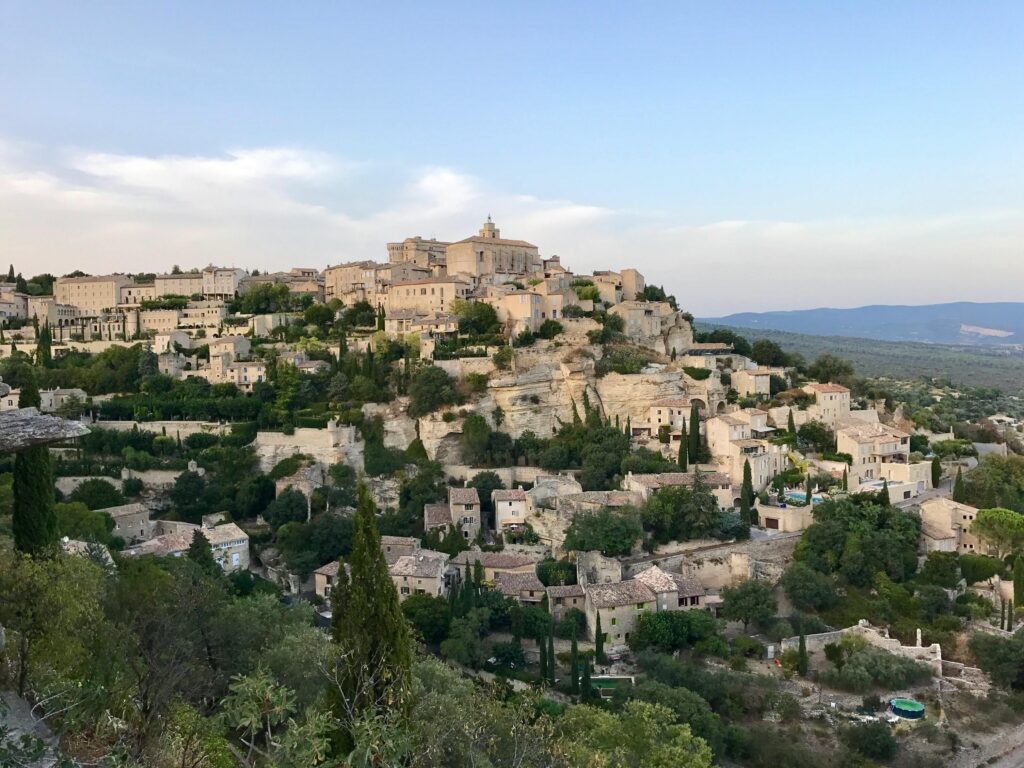
If you have seen one photograph of the Luberon, it was almost certainly of Gordes. The village sits on a steep rocky spur, its pale stone houses stacked up the hillside in tight concentric rings around a 16th-century château at the top. Seen from the famous viewpoint on the road from Cavaillon, especially in the late afternoon when the light turns the stone gold, it looks less like a real place and more like a painting someone made of what a Provençal village should look like.
Gordes is officially classified as one of Les Plus Beaux Villages de France — “the most beautiful villages of France” — and it lives up to the billing. It is also, inevitably, the most visited village in the Luberon. In July and August the narrow streets can be shoulder-to-shoulder with day-trippers. The trick is to come early or late: before 10 a.m. or after 5 p.m., when the tour buses have left and the village belongs again to the people who actually live there.
Just outside Gordes, down a winding road in a small hidden valley, is the Abbaye de Sénanque — a 12th-century Cistercian monastery where Cistercian monks still live and work today. In late June and early July, the fields in front of the abbey are planted with lavender, producing what is probably the most photographed image in all of Provence: the austere stone abbey framed by rows of purple. If you want that photograph, be there at dawn. By mid-morning in season, the crowds are intense.
Roussillon
If Gordes is stone gold, Roussillon is fire. The village is built on and out of the largest ochre deposit in Europe — a vein of iron-rich earth that produces every shade from pale yellow through orange, red, and deep burgundy. The buildings are made from it. The streets are made from it. The surrounding cliffs are made from it. The entire village glows.
For centuries, Roussillon was an industrial town. The ochre was mined and processed into pigments that were shipped all over Europe for use in paints and dyes. The industry collapsed in the 20th century when synthetic pigments took over, and the old quarries were abandoned. Today you can walk through them on the Sentier des Ocres — the Ochre Trail — a short, well-marked path through a landscape of red and orange cliffs, spires, and hoodoos that looks more like the American Southwest than the south of France. It is, improbably, one of the most surreal natural landscapes in Europe.
The village itself is small, colorful, and walkable in under an hour. The main square has cafés where you can sit with a glass of rosé and look out across the Luberon valley toward Gordes on its opposite hill. In the late afternoon, when the sun catches the ochre walls, the whole place turns into something that does not quite look real.
Ménerbes
Ménerbes is the village Peter Mayle actually lived in — though he never named it in the book, partly out of politeness and partly because he could see what was coming. It is a long, narrow village stretched out along the crest of a low ridge, quieter than Gordes, more austere than Roussillon, and full of the kind of slow, unhurried beauty that rewards people who come without a schedule.
There is not much to “do” in Ménerbes, which is the point. You walk the length of the village from one end to the other, stop for lunch at one of the small restaurants on the main street, visit the small truffle museum if it is open, and look out from the ramparts at the patchwork of vineyards and fields below. That is the whole itinerary. It takes about two hours. Those two hours will stay with you.
Bonnieux and Lacoste
These two villages sit across a small valley from each other, close enough that you can see one from the other, far enough apart that the drive between them takes fifteen minutes of narrow, winding road. Bonnieux is built into a hillside in steep terraces, with a church at the top reached by a climb up stone steps under enormous old cedar trees. The view from the church terrace out across the Luberon is arguably the best in the region.
Lacoste is smaller, quieter, and crowned by the ruins of a château that once belonged to the Marquis de Sade — yes, that Marquis de Sade. The château was largely destroyed during the French Revolution and is now owned by the fashion designer Pierre Cardin, who has restored parts of it and uses it for a summer opera festival. The rest of the village is a steep tangle of narrow lanes and honey-colored stone, often nearly empty, with a single small café at the top.
The Markets
If there is one thing you should plan your Luberon visit around, it is the markets. Each village in Provence has its own weekly market day, and the Luberon markets are among the best in France. They are not tourist markets — they are the markets where the people who live in these villages actually buy their food, flowers, cheese, olives, bread, and everything else. Tourists are welcome. The locals are not performing.
A rough rotation to plan around:
- Monday: Cadenet, Bédoin
- Tuesday: Gordes, Cucuron, Lacoste
- Wednesday: Sault, Saint-Rémy-de-Provence
- Thursday: Roussillon, Ménerbes
- Friday: Bonnieux, Lourmarin
- Saturday: Apt (the big one — the largest market in the Luberon)
- Sunday: Coustellet, Isle-sur-la-Sorgue (famous for its antique market as well)
Arrive by 9 a.m. to see the market at its best. By noon the vendors are starting to pack up. Bring a canvas bag. Bring cash. Bring an appetite.
Getting Around
The one difficulty of the Luberon is that public transportation between the villages is minimal. Buses exist but run infrequently. The honest answer is that you need a car — or a guide with a car — to see the Luberon properly. Distances are short (most villages are 10 to 20 minutes apart), but the roads are narrow, winding, and poorly signed, and parking in the popular villages can be a challenge in high season.
If you want the Luberon without the rental-car logistics, the simplest option is a guided tour. A three-day Provence tour from Paris typically bases you in Avignon and builds a full day of Luberon villages into the itinerary — usually Gordes, Roussillon, and a market stop, with a local guide who knows the back roads and the parking tricks. For travelers who want more time, a longer Provence trip can spend two full days in the Luberon and still not see all of it.
When to Go
The Luberon has essentially four seasons, each with its own reason to visit:
- Spring (April–May): cherry blossoms, poppies in the fields, mild weather, few crowds. Some of the best light of the year. Strongly recommended.
- Lavender season (mid-June to mid-July): the famous purple fields in bloom. Also the busiest and most crowded time, especially at Sénanque. Arrive at dawn.
- Late summer and harvest (late August–September): vineyards turning, warm days, cooler nights, the beginning of truffle season. Excellent.
- Winter (November–February): quiet, often empty villages, cheap hotels, and black truffle season in full swing. Cold and sometimes windy, but atmospheric and deeply authentic.
July and August are the hottest, most crowded months. The villages are still beautiful, but if you have flexibility, almost any other time of year will be more enjoyable.
The Luberon Mayle Found
Peter Mayle died in 2018, still living in Provence after more than 30 years, having long since accepted that his little book had changed the region in ways he could not have predicted. He was not unhappy about it. The Luberon he wrote about — the slow lunches, the stone villages, the eccentric neighbors, the markets, the rosé, the unhurried Provençal way of doing things — is still here. You just have to know where to look, and when.
Come in May. Stay in a small village instead of a big town. Skip the famous photo stops in the middle of the day and come back at dawn. Eat at the places with handwritten menus. Drink the rosé. Let the afternoon disappear at a café table. The Luberon will do the rest.
Ready to walk the streets of Gordes, Roussillon, and Ménerbes yourself? A three-day Provence tour from Paris bases you in Avignon and builds a full day of Luberon villages into the itinerary — markets, hilltops, and all.
Frequently Asked Questions
Which Luberon villages should first-timers see?
Gordes for the hillside panorama, Roussillon for the ochre cliffs, and one quieter pick such as Bonnieux, Lourmarin, or Menerbes. Three villages fill a day without rushing.
Do you need a car for the Luberon?
Yes, or a guided tour. No useful rail line crosses the massif, and the villages sit 10 to 20 minutes apart on hill roads. Park outside the walls and walk in.
When is the Luberon at its best?
May, June, and September: open lanes, mild heat, and everything open. July adds lavender at nearby Senanque and the Valensole plateau at the price of crowds.