Les Baux-de-Provence
A Cliff Village and an Immersive Art Quarry
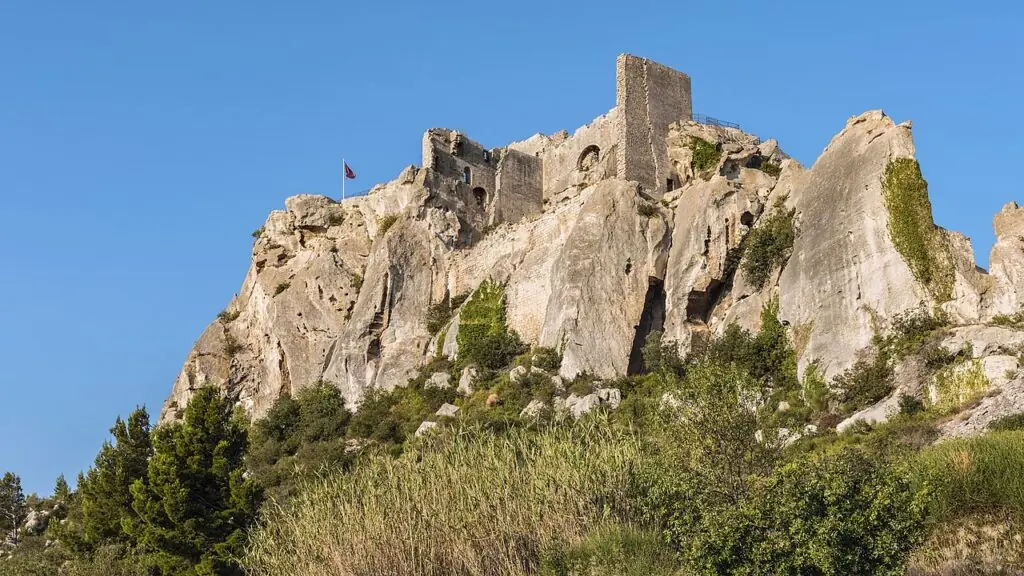
About 20 minutes south of Avignon, the flat farmland of the Rhône valley runs into a sudden wall of jagged white limestone — the Alpilles, a small chain of chalky mountains that look like the broken teeth of some enormous prehistoric animal. On top of one of the highest ridges, carved into and out of the rock itself, sits the medieval village of Les Baux-de-Provence. And directly below it, inside an abandoned stone quarry whose walls rise 50 feet straight up on all sides, is one of the strangest and most unexpectedly powerful art experiences in France: the Carrières de Lumières, an immersive digital art show projected across 7,000 square meters of raw quarry wall.
Most visitors come for one and discover the other. Both are worth the trip. Together, they make one of the most memorable half-days in Provence.
Les Baux: The Cliff Village
Les Baux is not a gentle hilltop village like Gordes or Roussillon. It is a raw, dramatic, almost defensive place — a medieval village and ruined castle built directly into a limestone plateau that drops off in sheer cliffs on three sides. From a distance, the village and the rock are nearly indistinguishable; the stone houses are made from the same limestone they sit on, and the ruined château at the top is so weathered that it seems to be dissolving back into the cliff. The effect is of a settlement that grew out of the mountain rather than being built on top of it.
The village is classified as one of the Plus Beaux Villages de France — the “most beautiful villages” — and it is one of the most visited sites in Provence. The old town consists of a single main street running up the spine of the ridge, lined with stone houses, small galleries, artisan shops, and restaurants. It is unapologetically touristy. The shops sell lavender soap and olive oil and Provençal fabrics, and in the summer the main street can feel like a conveyor belt of visitors. Come early or late if you want the village to yourself.
The real destination, though, is at the top: the Château des Baux, a vast ruined medieval fortress that covers the entire upper plateau of the cliff. The château’s history is violent and long — Les Baux was the seat of a powerful medieval noble family, the Lords of Baux, who controlled most of the surrounding region from this cliff for several centuries. They were among the most feared and independent nobles in Provence, involved in crusades, wars, feuds, and intrigues that fill an entire shelf of French history. At their peak, they ruled 79 towns and villages in the south of France and claimed descent from one of the three biblical Magi.
The château itself was largely destroyed in 1633 on the orders of Louis XIII, who was tired of the Baux lords’ rebellions and decided the simplest solution was to blow up their fortress. What remains is a sprawling clifftop ruin of roofless stone halls, crumbling towers, exposed foundations, and dramatic views in every direction. On a clear day you can see all the way to the Mediterranean coast, 30 kilometers south. On a windy day, the Mistral roars through the empty windows and arches of the ruined keep loudly enough to make conversation difficult.
The château grounds also contain working replicas of medieval siege weapons — a trebuchet, a catapult, a battering ram — that are demonstrated during the summer months. Kids love this. Adults, truthfully, also love this. Watching a full-scale trebuchet fling a 50-pound projectile off a cliff into the valley below is one of those experiences you do not forget.
The Carrières de Lumières
Just below the village, tucked into a side of the same limestone massif, is something completely different. The Carrières de Lumières — literally “the Quarries of Light” — is housed inside an enormous abandoned bauxite quarry. Not a cave, not a grotto: an actual old industrial stone quarry, the kind with flat walls 50 feet tall where workers cut limestone blocks out of the cliff for centuries. When the quarry was abandoned in the mid-20th century, it was left as a huge rectangular cavern — pillars and chambers and long corridors of raw, pale stone — open at the top but otherwise sealed in.
In 1976, the filmmaker Jean Cocteau’s producer Albert Plécy had an idea: what if you used this giant stone room as a projection surface? What if you filled the walls, the ceilings, the floors, the massive pillars — every flat surface in the entire quarry — with enormous projected images, and set it to music? The first experiments were primitive. The technology caught up in the 21st century. Today, the Carrières de Lumières is run by a company called Culturespaces, and it is one of the most successful immersive art experiences in the world.
Here is how it works in practice. You walk into the quarry through a modest entrance and find yourself in a vast dark stone chamber. Around you, on every surface — floor, walls, pillars, ceiling — enormous high-resolution images are being projected, often 30 or 40 feet tall. The projections move, blend, transform. Music plays through a surround sound system. There are no seats. You walk through the quarry at your own pace, wandering from one chamber to the next, standing inside the projections, which wash over your own body as you move. A full show lasts about 35 minutes and loops continuously, so you can stay for as long as you want.
Each year the Carrières de Lumières runs one or two major exhibitions, typically dedicated to a single artist or movement. Past shows have featured Van Gogh, Klimt, Bosch, Monet, Vermeer, Picasso, Chagall, Cézanne, and the Italian Renaissance masters. The Van Gogh show (which has been run multiple times due to demand) is particularly extraordinary — walking through a 50-foot-tall Starry Night or standing inside the swirling wheat fields of Auvers-sur-Oise is an experience that no flat museum reproduction can match. The images are sharp, the music is well-chosen, and the sheer scale transforms familiar paintings into something almost overwhelming.
Is it kitsch? Some art critics think so. A purist will tell you that standing inside a 40-foot projection of a Van Gogh painting is not the same as seeing the original brushstrokes on canvas. That is obviously true. But it misses the point. The Carrières de Lumières is not trying to replace the museum experience. It is trying to create something different: a way to experience familiar art at a scale and intensity that museum walls cannot provide. Kids, in particular, tend to come away from it having fallen in love with painters they previously found boring. That alone is worth the ticket.
How to Visit Both in One Trip
Les Baux and the Carrières de Lumières are within a five-minute walk of each other — the quarry entrance is at the base of the cliff below the village. The two sites require separate tickets, but most visitors do both on the same day. A realistic schedule:
- Morning (arrive by 9:30 a.m.): Visit the Carrières de Lumières first. The quarry is cool, dark, and climate-controlled, which makes it a perfect starting point on a hot summer day. Plan on 60–90 minutes inside.
- Late morning: Walk up the hill to Les Baux village. Explore the main street, the shops, and the small squares.
- Lunch: Eat in the village if possible. There are several restaurants with terraces offering views out over the Alpilles. Reservations recommended in high season.
- Afternoon: Visit the Château des Baux ruins. Allow at least 90 minutes at the top — there is a lot to explore, and the views alone are worth lingering over. If siege weapon demonstrations are happening, check the schedule when you arrive.
- Late afternoon: Walk back down. The village is particularly beautiful in the late afternoon light, when the limestone turns golden.
Both sites are extremely busy in July and August, and the narrow streets of the village can feel claustrophobic at peak times. If you have flexibility, come in May, June, September, or October — the weather is still excellent and the crowds are dramatically reduced.
What Else Is Nearby
Les Baux sits in the middle of some of the most beautiful countryside in Provence, and it combines naturally with several other major sites on a full-day itinerary from Avignon or Aix:
- Saint-Rémy-de-Provence. Ten minutes north. The town where Van Gogh spent his final year at the Saint-Paul-de-Mausole asylum, painting The Starry Night and dozens of other late masterpieces from his window. You can visit his actual cell, which has been restored, and walk the grounds of the asylum where he painted the olive groves and cypresses. It is one of the most moving Van Gogh sites in France.
- Glanum. On the outskirts of Saint-Rémy, a surprisingly extensive Roman and Greek archaeological site with the ruins of an entire ancient town — temples, baths, houses, a forum — plus a Roman triumphal arch and a funerary monument that were visible above ground for 2,000 years before the rest of the town was excavated. An underappreciated site.
- Arles. Thirty minutes south. The full Van Gogh and Roman Arles experience, if you have time to combine it.
- The olive oil mills of the Vallée des Baux. The valley around Les Baux is one of the most prestigious olive oil producing regions in France, with several AOC (protected origin) mills open to the public for tastings. The oil here is intensely green, slightly spicy, and worth bringing home.
A Note on the Name “Bauxite”
Here is a piece of trivia that almost nobody knows: the mineral bauxite — the ore from which almost all of the world’s aluminum is produced — was first discovered and named here, in the rocks of Les Baux-de-Provence, in 1821. The red-streaked stone that the 19th-century French geologist Pierre Berthier found in these hills turned out to be the main source of aluminum on earth. Every aluminum can, every aluminum foil wrapper, every aluminum airplane body in the world owes its name to this small village on a cliff in Provence. It is one of the more unexpected legacies of a place already so full of history that a minor detail like “also invented aluminum” almost doesn’t make the highlight reel.
Where Les Baux Fits in a Provence Trip
Les Baux is one of the essential day-trip destinations for anyone based in Avignon, Aix, or Saint-Rémy. It pairs naturally with Arles, Saint-Rémy, and the surrounding Alpilles villages on a single full day, and it fits easily into almost any organized Provence itinerary. A three-day Provence tour from Paris typically folds Les Baux and the Carrières de Lumières into a full day that also covers Arles and Saint-Rémy — a day that moves from Roman ruins to Van Gogh sites to a medieval cliff fortress to an immersive art quarry, all within a 20-kilometer radius. It is one of the most varied and memorable days you can have in Provence.
Two Places That Shouldn’t Work and Do
On paper, Les Baux and the Carrières de Lumières should not be the essential stops they are. A heavily touristed medieval village and a digital art show projected onto quarry walls — neither sounds like the authentic, slow, sun-drenched Provence that visitors come looking for. And yet both, against expectation, turn out to be genuinely unforgettable. Les Baux because the setting is so dramatic that no amount of souvenir shops can dilute it. The Carrières de Lumières because the experience of standing inside a 40-foot Van Gogh with music swelling around you is something you simply cannot get anywhere else.
Come with low expectations if you want. You will leave with high ones. That is part of the trick of Provence — the sites you approach with the most skepticism are often the ones that end up in the first three photos you show your friends when you get home.
Ready to stand on the cliff at Les Baux and walk inside a 40-foot Van Gogh? A three-day Provence tour from Paris typically folds Les Baux and the Carrières de Lumières into a full day that also covers Arles and Saint-Rémy — some of the best ground in Provence.
Frequently Asked Questions
What is Carrieres des Lumieres?
A former limestone quarry below Les Baux converted to an immersive art space: floor-to-ceiling projections set to music, with a new show each year. Visits run about 40 minutes inside.
Is Les Baux-de-Provence worth the climb?
Yes. The hilltop citadel ruins overlook the Alpilles and the plain to the sea, and the village below keeps its Renaissance lanes. Combined tickets cover the castle and the Carrieres.
How do you get to Les Baux?
By car or tour: 20 minutes from Saint-Remy or Arles, 40 from Avignon. Park in the numbered lots below the village and walk up; nothing drives inside.