Avignon
The City of Popes and the Bridge That Stops Halfway
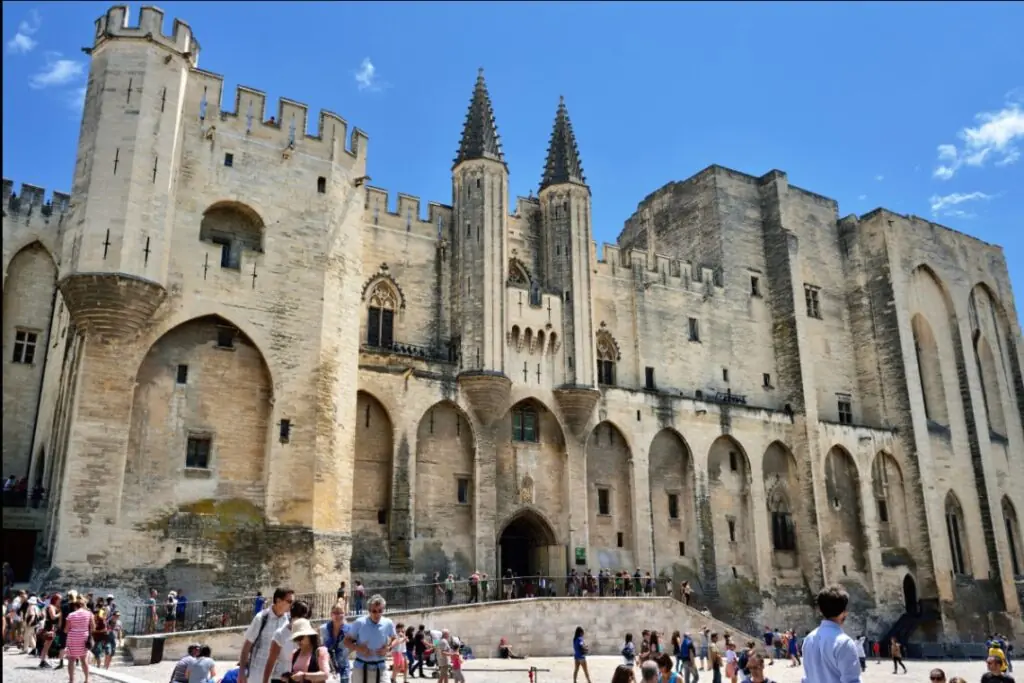
For 70 years in the 14th century, the center of Western Christianity was not Rome. It was a walled city on a bend in the Rhône River in the south of France, where seven consecutive popes held court in a fortress so massive it still dominates the skyline today. Avignon is the only city in the world that can make that claim, and walking through it now — past the ramparts, up the hill to the Palais des Papes, down to the famous bridge that stops halfway across the river — you get the strange, unforgettable feeling of a place that was briefly the capital of something much larger than itself, and then wasn’t.
It is also the easiest place in Provence to reach from Paris. The TGV from Gare de Lyon drops you at Avignon TGV station in under three hours. For most travelers, Avignon is where Provence begins.
How the Popes Ended Up in France
The story is almost too strange to be true. In 1309, after years of political chaos in Rome — rival families, street violence, a papacy that could not safely stay in its own city — Pope Clement V, a Frenchman, decided to move the papal court north. He picked Avignon. It was technically not even in France at the time; it belonged to a vassal of the papacy, which gave it a convenient legal status. More importantly, it was close to the French king, who had significant influence over Clement.
What was meant to be a temporary relocation lasted 68 years and seven popes. Rome was left behind, furious. The French popes built a court, a bureaucracy, and — most visibly — an enormous fortified palace on the rocky outcrop in the middle of the city. They also built walls around Avignon, the same walls you see today: nearly three miles of honey-colored stone, almost entirely intact, one of the best-preserved medieval city walls in Europe.
By the time the papacy finally returned to Rome in 1377, Avignon had been permanently transformed. And even then, the story wasn’t over. A rival faction of cardinals elected their own pope and sent him back to Avignon, kicking off the Western Schism — nearly 40 more years during which there were two popes at once, one in Rome and one in Avignon, each insisting the other was a fraud. Medieval Christendom has never been more confused.
The Palais des Papes
The Palace of the Popes is the largest Gothic palace in the world. Not the largest Gothic cathedral — the largest Gothic palace. It covers roughly 15,000 square meters. The walls are up to 18 feet thick in places. It was built in two phases by two different popes with two very different temperaments, and you can see the seam where one ends and the other begins: the austere “Old Palace” of Benedict XII, a former monk who wanted something severe and fortress-like, and the more ornate “New Palace” of Clement VI, who bought Avignon outright in 1348 and wanted his court to look like the center of the civilized world.
Inside, most of the furnishings are long gone — stripped during the French Revolution, when the palace served as a barracks and then a prison — but the sheer scale is what stays with you. The Grand Chapel alone is larger than most cathedrals. The frescoes in the private papal chambers, painted by Italian artists the popes brought north with them, are still there, half-hidden in rooms you have to hunt for. Allow two hours minimum. Three is better.
The Bridge That Stops Halfway
Just below the palace, at the edge of the old city, is the Pont Saint-Bénézet — better known as the Pont d’Avignon, the bridge from the French nursery rhyme that every French child learns before they can read. Sur le pont d’Avignon, l’on y danse, l’on y danse…
The bridge is famous for two things: the song, and the fact that it doesn’t reach the other side of the river. Only four of its original 22 arches remain. The rest were washed away, one flood at a time, starting in the 17th century. The city eventually gave up rebuilding it. What’s left is a stub of a bridge extending halfway across the Rhône, stopping abruptly in the middle of the water, with a small chapel perched on one of the piers.
You can walk out to the end. It is one of the most photographed spots in France, and deservedly so — the view from the end of the broken bridge, looking back at the walls and the palace rising above them, is the image that ends up on every Provence guidebook. And the nursery rhyme, by the way, is slightly wrong. People didn’t dance on the bridge. They danced under it, on an island in the river that was a popular gathering spot in the Middle Ages. The grammar got mangled somewhere along the way and nobody bothered to fix it.
The Rest of the City
Avignon is not just the palace and the bridge. Inside the walls, the old town is a warren of narrow streets, small squares, and hidden courtyards that reward slow walking. A few things worth seeking out:
- Place de l’Horloge. The main square, lined with cafés and plane trees. This is where you sit with a glass of rosé at the end of the day and watch the light change on the façades.
- Les Halles. The covered food market, open every morning except Monday. The exterior is covered in a famous vertical garden of living plants. The interior is where the city shops — cheese, olives, produce, Provençal specialties, and some of the best rotisserie chicken in France.
- Rue des Teinturiers. The old dyers’ street, running along a small canal with giant water wheels still turning. Genuinely atmospheric, lined with artisan shops and small restaurants.
- The Musée du Petit Palais. A museum of early Italian Renaissance painting — Botticelli, Carpaccio, and many others — housed in the former palace of the archbishop, right next to the Palais des Papes. Often nearly empty. One of the great under-visited museums in France.
- The ramparts walk. You can follow most of the old walls around the city. It takes about an hour and gives you a completely different perspective on Avignon’s size and shape.
When to Go
Avignon is a year-round destination, but the summer is something else. In July, the city hosts the Festival d’Avignon, one of the largest performing arts festivals in the world. For three weeks, every courtyard, church, and available indoor space becomes a theater. The population of the city roughly doubles. If you want the festival, plan months ahead for a hotel. If you want Avignon without the crowds, come in May, June, September, or early October — still warm, still sunny, and the city is yours.
Winter has its own charm. The mistral wind that blows down the Rhône valley can be cold and relentless, but the light on the palace walls in January is unlike anything else in France, and the restaurants are full of locals instead of tourists.
Avignon as a Base for Provence
Here is the practical reason Avignon matters so much: it is the best base for exploring Provence. From Avignon you can reach the Pont du Gard in 25 minutes by car. The Luberon villages — Gordes, Roussillon, Ménerbes — are 45 minutes east. Arles, with its Roman amphitheater and Van Gogh connections, is 30 minutes south. Les Baux-de-Provence and the Carrières de Lumières are 40 minutes. Châteauneuf-du-Pape, the legendary wine village, is 15 minutes up the road.
In other words, you can base yourself inside the walls of a medieval city for three or four days and see most of what makes Provence famous without ever moving your suitcase. This is exactly why most organized Provence trips from Paris use Avignon as their hub. A Provence overnight trip from Paris will put you on the TGV, check you into a hotel inside the Avignon walls, and build a tour of the surrounding region around that base — hilltop villages, markets, Roman sites, and the Palais des Papes itself.
The City the Popes Left Behind
There is something moving about Avignon that is hard to name. It is the feeling of a city that was, for a brief and improbable moment, the most important place in the Western world — and then, just as suddenly, wasn’t. The popes went home. The schism ended. The river kept knocking down the bridge. And Avignon simply stayed: smaller than it had been, quieter than it had been, but still standing, still walled, still crowned by the biggest Gothic palace ever built.
Walk up to the top of the palace at sunset and look out over the red rooftops toward Mont Ventoux in the distance. You can see why the popes stayed for 70 years. You can also see why they eventually went back to Rome. And you can see why, 700 years later, people from all over the world still come here to stand on a broken bridge and sing a song they learned as children.
Ready to stand under the walls of the Palais des Papes yourself? A Provence overnight trip from Paris will get you there on the TGV, put you up inside the medieval walls, and build the rest of Provence around Avignon as your base.
Frequently Asked Questions
How do you get to Avignon from Paris?
The TGV runs direct from Paris Gare de Lyon to Avignon TGV in about 2 hours 40 minutes, with a shuttle or short taxi into the walled city. Avignon works as a Provence base as well as a day stop.
What is the Palais des Papes?
The fortress-palace where seven popes ruled Western Christianity through most of the fourteenth century, the largest Gothic palace ever built. Allow two hours with the ticketed interior.
Is the Avignon bridge real?
Yes. The Pont Saint-Benezet of the song survives as four arches reaching partway across the Rhone; floods took the rest centuries ago, and the stub is the monument.