Arles and Van Gogh
The Year That Changed Painting Forever
On February 20, 1888, a 34-year-old Dutch painter named Vincent van Gogh stepped off a train in the small southern French city of Arles. He had been living in Paris for two years, drinking too much, arguing with other artists, and painting work that was beginning to get noticed but hadn’t yet found its voice. He was looking for something — brighter light, cheaper rent, a place where he could work without distraction. He had bought a one-way ticket, packed his paints, and gone south because his brother Theo had told him the light in Provence was like nothing else in France.
He would stay in Arles for 15 months. In that time, he would paint roughly 300 canvases and drawings — some of the most famous paintings in the history of Western art. The Night Café. Café Terrace at Night. The Bedroom. The Sunflowers. The Yellow House. Starry Night Over the Rhône. The harvesters, the postmen, the peasant women, the fields of wheat and olive trees under skies he painted in colors no one had used before.
He would also, during those 15 months, cut off part of his own ear, be committed to a hospital, and leave Arles for the asylum at Saint-Rémy-de-Provence, where he would spend another year before his death. But in Arles, for a little while, he found what he had come south looking for.
Arles today is a small, sunbaked city of 50,000 people on the Rhône river, and it is arguably the best place in the world to walk in the literal footsteps of Vincent van Gogh. Not because it has been turned into a Van Gogh theme park — it hasn’t — but because so much of what he painted is still there, still recognizable, still in the exact spots he set up his easel.
The City Van Gogh Found
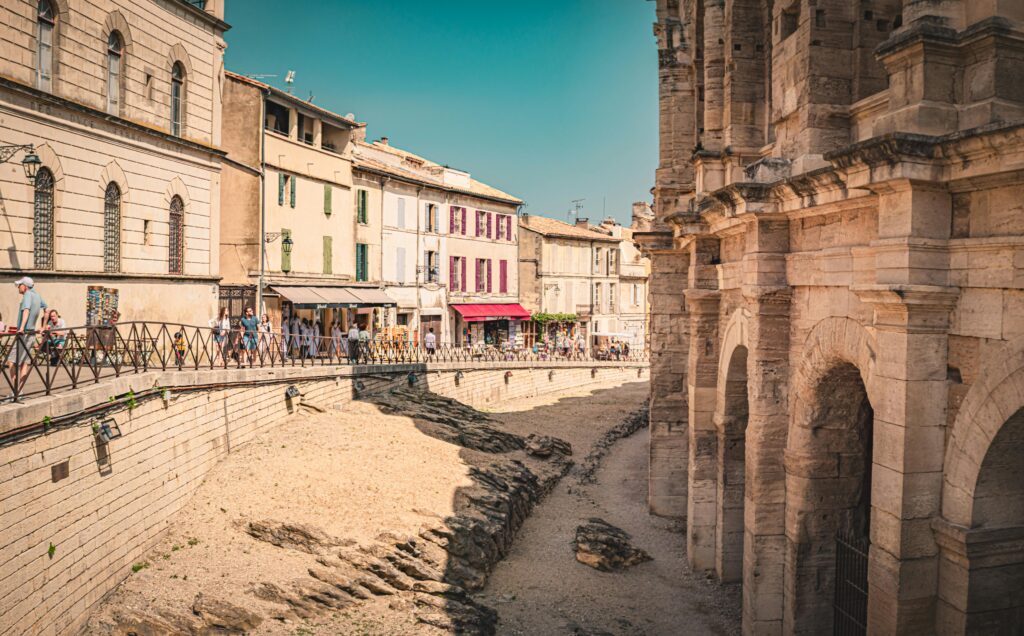
Here is what often surprises first-time visitors: Arles is much older than Van Gogh. By almost two thousand years. When Van Gogh arrived in 1888, he was walking through a city that had already been a major Roman settlement, a medieval trading center, a pilgrimage stop on the road to Santiago de Compostela, and a provincial capital. The Roman amphitheater at the center of the city — still standing, still in use for bullfights and concerts — was built around 90 AD, when Arles was one of the largest Roman cities in Gaul. The Romans called it Arelate, and at its height it was home to 100,000 people, with an amphitheater, a theater, a forum, Roman baths, and a major river port.
Van Gogh knew all of this. He wandered through the Roman arena. He painted in the Alyscamps, an ancient Roman necropolis on the edge of town where early Christians had been buried for more than a thousand years. He was fascinated by the layered history of the place. But he didn’t paint the Romans. He painted the people and the fields and the light of the Arles that existed around him — postmen, cafés, wheat fields, drawbridges, sunflowers in a vase on a wooden table.
The Yellow House
The building at the center of the Van Gogh story in Arles was a small, modest house at 2 Place Lamartine, just outside the old city walls near the train station. Van Gogh rented four rooms on the ground floor in May 1888 and painted the exterior bright yellow. He called it, in letters to his brother, “the Yellow House” — and it became the subject of one of his most iconic paintings, a canvas that shows the house glowing in the afternoon sun against a deep blue sky, with a single small figure in front and a railway bridge in the background.
The Yellow House is the reason Arles matters in the Van Gogh story. It is where he planned to found an artist’s colony — the “Studio of the South,” as he called it in his letters — a place where painters who were tired of Paris could come and work together in the Provençal light. It is where he lived with Paul Gauguin for nine tumultuous weeks in the autumn of 1888. It is where, on December 23 of that year, after a violent argument with Gauguin, Van Gogh sliced off part of his own ear with a razor and delivered it, wrapped in newspaper, to a woman at a local brothel.
The Yellow House itself is no longer standing. It was badly damaged in an Allied bombing raid in 1944 and demolished after the war. What remains at the site today is an empty corner at 2 Place Lamartine, with a plaque identifying where the house once stood, and — crucially — the railway bridge Van Gogh painted in the background is still there, more or less unchanged, in the exact position he showed it in the picture. You can stand on the empty lot where the Yellow House used to be, look toward the railway bridge, and see the composition of the painting unfold in front of you in three dimensions. It is one of the stranger pilgrimages in French cultural history, and one of the more moving.
What You Can Still See That Van Gogh Painted
The remarkable thing about Arles is how much of Van Gogh’s subject matter is still identifiable. The city has marked many of the exact spots where he set up his easel with small bronze plaques in the sidewalk and weatherproof reproductions of the paintings mounted on stands at eye level, so you can stand in the spot and compare the painting to the scene directly in front of you. A self-guided walking trail connects the major sites and takes about two hours at a slow pace.
Some of the most famous stops:
- Café Terrace at Night (Place du Forum). The yellow café with the blue night sky and the cobbled square. The café building is still there, now called Le Café Van Gogh, painted yellow in obvious tribute, and heavily touristed. The square itself is unchanged. At night, when the café lights come on, you can see the composition exactly as Van Gogh painted it — though the modern reality is a bit more crowded with tourists looking for the same photograph.
- Starry Night Over the Rhône. The spot where Van Gogh set up his easel to paint the reflections of the gas lamps along the riverfront at night is on the quay just north of the old city. The specific bend in the river, the angle of the lights, and the position of the stars are still recognizable from the painting. The best visit is at dusk, when the modern equivalent of the gas lamps comes on along the water.
- The Alyscamps. The Roman necropolis at the edge of town, which Van Gogh painted several times in autumn, with rows of sarcophagi lining a long avenue under orange and yellow trees. It is still one of the most atmospheric places in Arles — especially in October, when the light and the colors are exactly what Van Gogh was chasing.
- The Hospital Courtyard (Espace Van Gogh). After the ear incident, Van Gogh was committed briefly to the local hospital, where he painted the central courtyard garden from his window. The courtyard has been restored to match his painting — the flowers, the walkway layout, the colors of the walls — so that you can stand in the real garden and compare it to the painted one. It is eerily exact.
- The Langlois Bridge (now the Van Gogh Bridge). The small wooden drawbridge outside the city that Van Gogh painted repeatedly in 1888. The original is gone, but a near-identical drawbridge of the same period has been relocated to a canal on the outskirts of town and restored as a Van Gogh landmark. It is a short drive or a long walk from the center, but it is the closest you can come to the original scene.
The Rest of Arles
Van Gogh is the main draw, but he is not the only reason to come. Arles is one of the great Roman cities of France, and its ancient monuments are almost as essential as anything related to the Dutch painter:
- The Roman Amphitheater (Arènes d’Arles). Still standing, still in use, and one of the best-preserved Roman amphitheaters in the world. It seated 20,000 spectators in Roman times and hosts bullfights and events today. Climb to the top tier for the view over the red-tile roofs of the old city.
- The Roman Theater (Théâtre Antique). A more ruined but still impressive Roman theater from the 1st century BC, a short walk from the amphitheater. Two elegant columns from the original stage wall are still standing, looking out over the modern city.
- The Cryptoporticus. An underground Roman gallery beneath the old forum of Arles, used as storage and foundation for the Roman-era public buildings above. You can walk through the tunnels, which are remarkably intact and atmospheric.
- Église Saint-Trophime. A Romanesque church on the main square with a carved stone portal that is one of the finest examples of 12th-century Provençal Romanesque sculpture anywhere. The adjoining cloister is equally remarkable.
- The Saturday Market. The main Saturday market in Arles stretches for nearly two kilometers along the boulevards around the old city walls and is one of the largest and most atmospheric markets in Provence. Locals shop here. Tourists should show up early, stay late, and bring cash.
- The Fondation Vincent van Gogh. A relatively new contemporary art museum housed in a restored 15th-century mansion, dedicated to Van Gogh’s legacy and its influence on contemporary artists. Rotating exhibitions usually include one or two original Van Gogh works on loan alongside modern pieces that respond to his.
The Camargue: What’s Just Outside Town
Arles sits at the edge of the Camargue — a vast, flat delta where the Rhône river meets the Mediterranean. The Camargue is one of the most unusual landscapes in France: salt marshes, shallow lagoons, rice paddies, and wide open flats grazed by wild white horses, black fighting bulls, and enormous flocks of pink flamingos. It is a protected natural park and a birdwatcher’s paradise, and it makes for an easy half-day trip from Arles by car or guided tour.
The Camargue is also where you will find Saintes-Maries-de-la-Mer, a small seaside town famous for its fortified church, its annual Roma pilgrimage in May, and its long beaches. If you have a full day to spare in Arles, driving out through the Camargue to the coast is one of the best side trips in Provence.
When to Go
Arles is at its best in spring and autumn — April to early June, and mid-September through October. The light in those months is soft and golden, the crowds are manageable, and the temperatures are perfect for walking the Roman ruins and the Van Gogh trail without heat exhaustion.
Summer is hot — often 95°F or more — and crowded, though it has its own atmosphere. The famous Arles photography festival, Les Rencontres d’Arles, runs from early July through late September and turns the whole city into an enormous open-air exhibition of contemporary photography. If you are a photography fan, plan your trip around it.
Winter is quiet, cool, and often nearly empty — a chance to see the Roman monuments and the Van Gogh sites without crowds. The Mistral wind can be fierce from December through February, but on a clear winter day Arles has a stripped-down austerity that many visitors find more memorable than the high-season version.
Where Arles Fits in a Provence Trip
Arles is often overlooked in favor of Avignon, its larger and more famous neighbor 35 minutes to the north. This is a mistake. Arles is smaller, quieter, more walkable, and arguably more layered — Roman, medieval, and 19th-century, stacked on top of each other in a compact old city you can cross on foot in 20 minutes. For travelers specifically interested in art history, Arles is essential. For travelers interested in Roman Provence, it is arguably more important than Avignon. For travelers who simply want a small, beautiful Provençal city to spend a day or two in, it is one of the best choices in the region.
Most organized Provence itineraries from Paris include Arles as a full-day stop, often paired with Les Baux-de-Provence, the Carrières de Lumières, and Saint-Rémy-de-Provence — the asylum where Van Gogh went next and where he painted The Starry Night. A five-day Art Tour of Provence from Paris is built specifically around this story, tracing Van Gogh, Cézanne, and the other painters who fell in love with the Provençal light, with expert guides at each of the major sites.
The Light He Came For
There is one thing no guidebook can really prepare you for, and it is the thing that brought Van Gogh here in the first place: the quality of the light. Provence light is different from any other light in France. It is harder, cleaner, more directional, and more saturated. Shadows are blacker. Colors are brighter. White walls turn almost fluorescent in the afternoon sun. The sky at midday is a deeper, harder blue than the sky over Paris. Van Gogh saw this light for the first time on that February morning in 1888, and within weeks his palette had exploded into the chrome yellows, cobalt blues, and cadmium oranges that define his final great period.
Stand in the Place du Forum at 4 p.m. on a clear afternoon in May or October. Look at the yellow walls of the old café. Look at the blue sky above the rooflines. Look at the deep shadow of the plane trees on the cobblestones. You are seeing exactly what Van Gogh saw. The paintings were not exaggerated. He was simply painting what was there.
That, in the end, is why Arles is worth the trip. Not to find Van Gogh — you can see his paintings in any museum — but to see the world he was painting from. Once you have seen the light in Arles, every Van Gogh canvas you encounter for the rest of your life will look a little different.
Ready to walk the streets Van Gogh painted? A five-day Art Tour of Provence from Paris traces Van Gogh and Cézanne through Arles, Saint-Rémy, Aix, and the landscapes that inspired some of the most important paintings of the 19th century.
Frequently Asked Questions
What did Van Gogh paint in Arles?
Around 300 works in 15 months from 1888, including the Sunflowers, the Yellow House, the Night Cafe, and Starry Night Over the Rhone. Marked viewpoints around town match canvas to spot.
Are any Van Gogh paintings in Arles?
No originals hang permanently in Arles; the Fondation Vincent van Gogh shows rotating loans. The permanent collections live in Amsterdam, Paris, and New York, and the town itself is the exhibit.
What else is worth seeing in Arles?
The Roman arena, still staging events after 1,900 years, the Roman theatre, the Saturday market along the Lices, and Luma Arles’ Frank Gehry tower for contemporary art.