Aix-en-Provence
Cézanne’s Hometown and the Elegant Capital of Old Provence
If Avignon is the dramatic, walled, medieval Provence — popes and palaces and a broken bridge — then Aix-en-Provence is its refined, slightly aristocratic cousin. Aix (pronounced simply “ex”) is a city of fountains, plane trees, café terraces, and 17th-century townhouses in warm honey-colored stone. It was the historic capital of Provence for centuries, the seat of the regional parliament, and the hometown of the painter who arguably did more than anyone to invent modern art: Paul Cézanne.
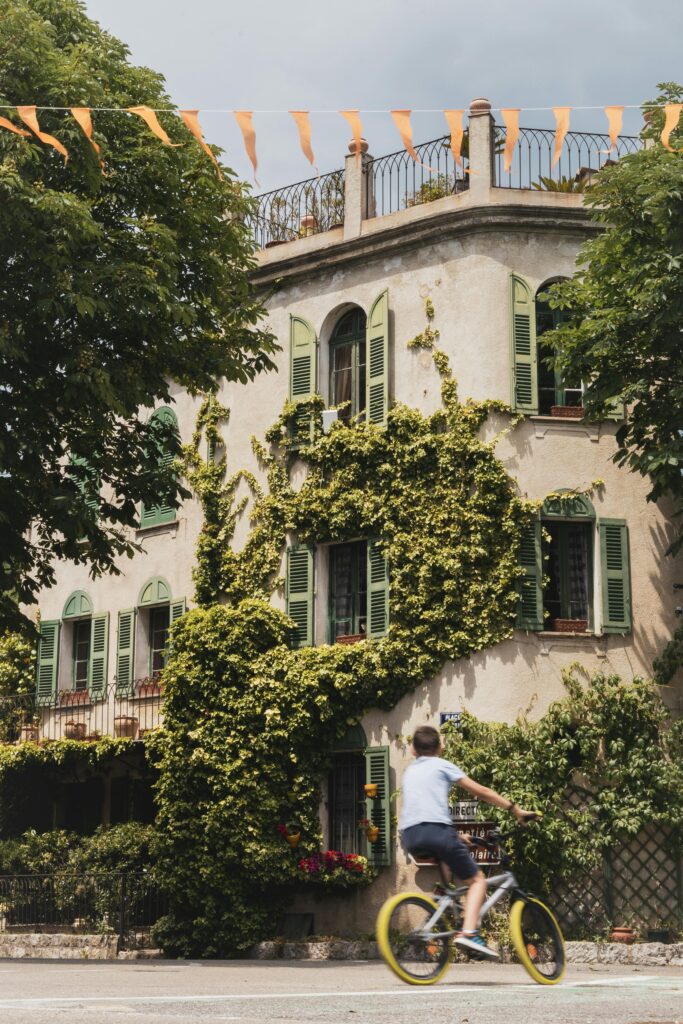
Walking through Aix today, you get the sense of a city that has always been comfortable with itself. It does not clamor for your attention the way Avignon does. It simply waits, with its fountains burbling and its cafés half-full, for you to notice how good it is.
The Cours Mirabeau
Every visit to Aix begins, whether you plan it or not, on the Cours Mirabeau. This is the grand central boulevard of the old town — a wide avenue laid out in 1649, lined on both sides with four rows of plane trees whose branches meet overhead in summer to form a green tunnel of shade. On one side: cafés, including the legendary Les Deux Garçons, where Cézanne and his childhood friend Émile Zola used to argue about art and literature. On the other: elegant 17th- and 18th-century hôtels particuliers, the private townhouses of Aix’s old aristocracy, many with carved stone doorways and wrought-iron balconies.
Down the middle of the Cours Mirabeau run four fountains, including the Fontaine Moussue — the “mossy fountain” — fed by a warm thermal spring and completely covered in a soft green coat of moss and algae. It is one of the strangest and most beautiful things you will see in Provence. In the winter, on cold mornings, it steams.
The City of a Thousand Fountains
Aix is sometimes called the city of a thousand fountains. The real number is closer to a hundred, but the nickname fits the feel of the place. You cannot walk for more than a few minutes in the old town without coming across one: a small square with a stone basin, water trickling from a lion’s mouth or a carved dolphin, the sound of it bouncing off the surrounding walls. The fountains are why the city exists. Aix was founded by the Romans in 123 BC as Aquae Sextiae — the waters of Sextius — built around the natural thermal springs that still feed many of the fountains today.
Some to look for: the Fontaine des Quatre Dauphins, a quiet 17th-century fountain in the Mazarin quarter with four stone dolphins spitting water; the Fontaine de la Rotonde, the enormous traffic-circle fountain at the western end of the Cours Mirabeau, built in 1860 and topped with three statues representing Justice, Agriculture, and the Fine Arts; and the Fontaine d’Albertas, tucked into a small square surrounded by identical mansions, which looks exactly like a stage set for an 18th-century play.
The Old Town
North of the Cours Mirabeau is the old town proper — a tangle of narrow pedestrian streets, small squares, and hidden courtyards that invites the kind of slow, directionless wandering Aix was made for. A few highlights:
- Place de l’Hôtel de Ville. The main square of the old town, dominated by the ornate Baroque clock tower and a flower market several mornings a week. The town hall itself, with its carved wooden doors, is an architectural set piece.
- Cathédrale Saint-Sauveur. A church that was built over so many centuries it contains a Romanesque nave, a Gothic nave, a Renaissance façade, and a baptistry with Roman columns still in place from the 5th century. It is architectural history in one building.
- Place Richelme. A small square that hosts a daily fresh produce market. Small, lively, local — nothing like the tourist markets of larger cities.
- Place des Cardeurs. Restaurant row in the old town. If you want to eat outside on a summer evening surrounded by the hum of dozens of other tables, this is the square.
- The Mazarin quarter. South of the Cours Mirabeau, laid out in the 17th century as a planned residential district for the wealthy. Quieter, more formal, and full of hidden courtyards and mansions.
Cézanne
Paul Cézanne was born in Aix in 1839 and died in Aix in 1906, and in between he changed painting. He is the figure Matisse called “the father of us all,” the one Picasso called “the father of us all,” the one who took Impressionism’s preoccupation with light and pushed it toward something entirely new — the structural, almost architectural vision of the world that would eventually become Cubism and everything after.
And he did it, for the most part, by painting the same things over and over: a few local landscapes, a few bowls of fruit, a few groups of bathers, and one mountain. That mountain — Montagne Sainte-Victoire — rises dramatically east of Aix, a long limestone ridge that catches the afternoon light in a way Cézanne could never stop trying to paint. He painted it more than 60 times. You can still drive out to the spots where he set up his easel. The mountain looks exactly as he painted it. This is one of the small miracles of visiting Aix: the landscapes are still there, unchanged, waiting.
The city has preserved several key Cézanne sites. The Atelier Cézanne — his last studio, on a hillside just outside the old town — has been kept almost exactly as he left it on the day he died. His coat still hangs on the wall. His paint-spattered easel is still in the corner. The skulls and bottles he used in his still lifes are on the shelves. It is one of the most affecting artist’s studios in the world, precisely because so little has been done to it. You walk in and you are standing inside one of his paintings.
The Bastide du Jas de Bouffan, his family’s country estate, is also open to visitors. It’s where he painted many of his early works. And a self-guided “In the Footsteps of Cézanne” walking trail, marked with small bronze C’s embedded in the sidewalks, will take you past his birthplace, his schools, the cafés he frequented, and the studio.
Aix Versus Avignon: Which Should You Base In?
Most first-time visitors to Provence face this choice. The honest answer is that they offer different things. Avignon is better for the Luberon, Châteauneuf-du-Pape, the Pont du Gard, and anything north and west. Aix is better for Cézanne, Mont Sainte-Victoire, Marseille and the Calanques (30 minutes south), and anything toward the coast. Avignon feels medieval. Aix feels 18th-century. Avignon is walled. Aix is open. Avignon has the big dramatic monuments. Aix has the atmosphere of a city you could actually live in.
If you have five or six days in Provence, the best answer is often both: a few days in Avignon, then a transfer south to Aix. If you only have two or three days, pick the one whose mood speaks to you. You can’t go wrong. A five-day Provence tour from Paris typically folds both cities into a single trip, along with the Luberon villages, a cooking class, and wine tastings — which is about as complete a picture of the region as you can get in one week.
When to Go
Aix is pleasant year-round but genuinely spectacular in late spring and early autumn. In May and June the plane trees are fully leafed out, the cafés are full, and the temperatures are perfect for outdoor dining without the intense heat of July and August. September is similarly beautiful, with the added bonus that the summer tourist crowds have thinned and the locals are back from their own holidays.
July and August are hot — often over 90°F — and crowded, but they are also when Aix is at its most alive. The city hosts the Festival d’Aix-en-Provence, one of the most prestigious opera festivals in Europe, in July. Book far ahead if you want tickets.
Winter is quieter, cheaper, and has a beauty of its own. The mistral can be sharp, but the light on the honey-colored stone in January is something Cézanne himself tried for decades to capture.
A City That Rewards Slowness
The mistake visitors sometimes make in Aix is trying to “see” it the way you would see Rome or Paris — marching from one monument to the next with a checklist. Aix is not built for that. It is built for sitting at a café on the Cours Mirabeau at eleven in the morning with a coffee. It is built for wandering the old town without a map and getting lost in a small square with a fountain you weren’t expecting. It is built for driving out of town in the late afternoon to watch the light change on Sainte-Victoire the way Cézanne did, over and over, for 30 years.
That is the Aix pace. Match it and the city opens up. Fight it and you’ll wonder what the fuss is about.
Want to see Aix, Mont Sainte-Victoire, and the rest of Provence on a properly paced trip? A five-day Provence tour from Paris folds Aix-en-Provence together with Avignon, the Luberon villages, a cooking class, and wine tastings into a complete introduction to the region.
Frequently Asked Questions
What is Aix-en-Provence known for?
Cezanne’s home city: his preserved studio on the Lauves hill, the Cours Mirabeau’s plane-tree promenade, seventeenth-century mansions, and some of the best food markets in the south.
Can you visit Cezanne’s studio?
Yes. The Atelier de Cezanne is kept as he left it and runs timed visits; book ahead in season, and pair it with the Terrain des Peintres viewpoint over Mont Sainte-Victoire.
How far is Aix from Marseille?
About 30 minutes by car or bus and a similar run by rail via Aix TGV. The two make an easy paired day, city morning and Aix afternoon.